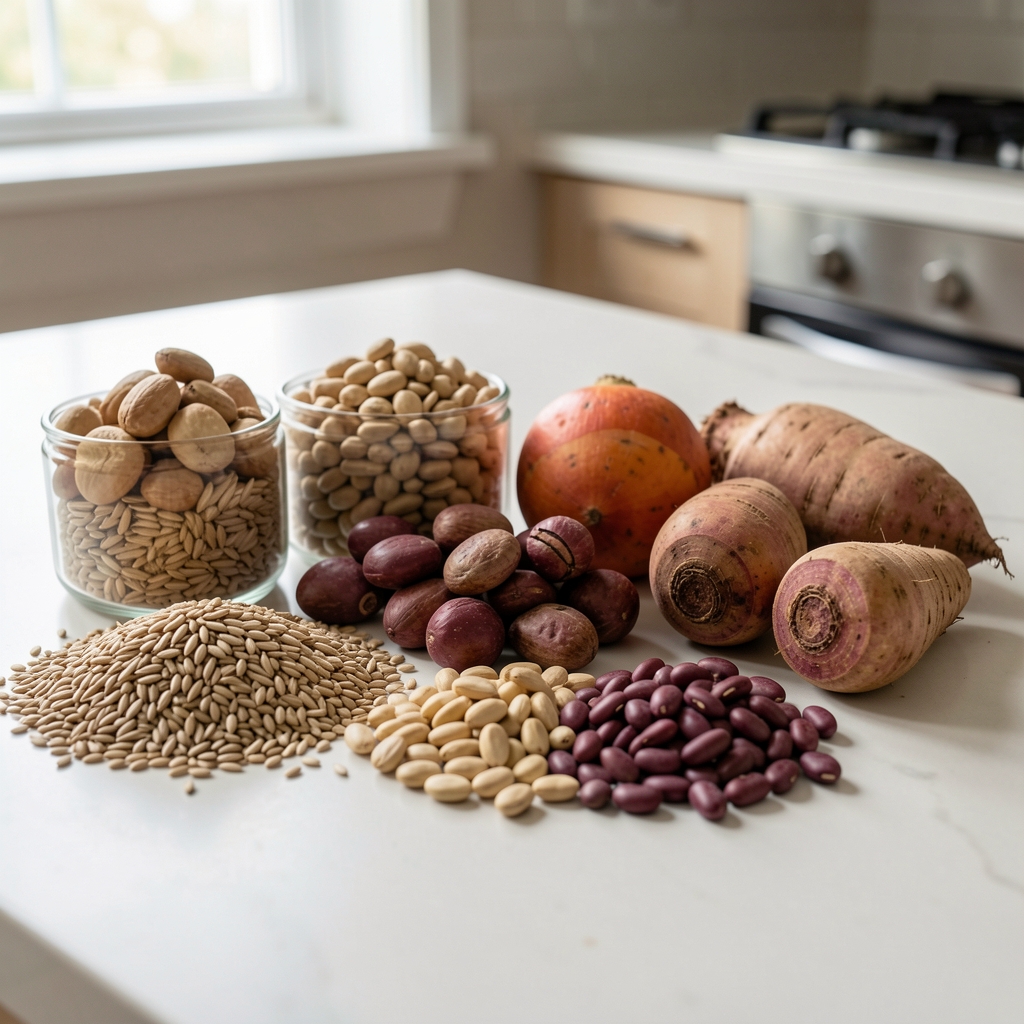
There is a particular kind of documentary evidence in the weekly food shop that nutrition professionals rarely reference: not the food log, not the calorie count, but the physical composition of what a person chooses to carry out of a market or supermarket on a given Thursday afternoon. Looked at over several months, that basket becomes a surprisingly accurate record of how a person's relationship with food — and with their own weight — is actually shifting.
The Basket as an Observational Portrait
In more than a decade of working with individuals on everyday nutrition, one pattern stands out above all others: the people who describe their weight as stable are rarely those who eat perfectly. They are, almost without exception, the people whose shopping baskets are consistent. Not pristine. Consistent. The basket contains roughly the same proportion of vegetables to processed items each week, the same quantity of whole grains, the same two or three fruit varieties that happen to be in season.
This consistency is not the result of discipline in any conventional sense. It is more often the result of having established a rhythm — a pattern of purchasing that runs on something closer to habit than to resolve. The person does not decide each Thursday whether to buy broccoli; they simply buy broccoli because broccoli is what they buy. The nutritional value of this consistency is difficult to overstate.
Conversely, the baskets that shift dramatically from week to week — flush with vegetables one fortnight, dominated by ready meals the next — tend to belong to people whose weight is also fluctuating. Not because of any direct causal mechanism between, say, a packet of biscuits and a particular number on the scale, but because the variability in the basket reflects a deeper instability in the person's relationship with eating itself.

What Proportion of Vegetables Actually Matters
The simplest single measure of a basket's nutritional character is the proportion of its contents that are whole, unprocessed plant foods: vegetables, fruit, legumes, whole grains. This is not a novel observation — it sits at the base of almost every evidence-informed dietary framework — but its practical application to the shopping basket as an object of nutritional study has received relatively little attention in popular nutrition writing.
From an observational standpoint, baskets where plant foods comprise roughly half or more of the volume tend to correlate with eating patterns that support a sense of fullness between meals. This is largely attributable to dietary fibre and water content: both slow gastric emptying, extend the period of satiety after eating, and reduce the likelihood of reaching for energy-dense snacks in the mid-afternoon. None of this is complicated, but it requires that the vegetables actually make it into the basket in the first place.
What is more interesting, nutritionally, is the question of variety within that plant-food proportion. A basket containing the same three vegetables every week for six months provides a narrower range of micronutrients than a basket that shifts with the seasons — moving from root vegetables in winter through to leafy greens and brassicas in spring, stone fruit and tomatoes in summer. The body's nutritional requirements are not fixed; seasonal eating, as a practice, tends to introduce a natural rotation of nutrients that no supplement programme replicates quite as effectively.
"The basket is not a record of what a person intends to eat. It is a record of what they actually believe, in their quieter moments, that food is for."
Processed Food Reliance and the Weight Conversation
The presence of heavily processed foods in a basket is not, in itself, a problem. The editorial position of this publication has never been one of prohibition. A weekly basket that contains a bag of crisps alongside a selection of seasonal vegetables is not a basket that requires intervention. What merits attention is the proportional displacement: when ultra-processed items begin to crowd out the space that would otherwise be occupied by whole foods, the basket starts to reflect — and reinforce — a particular kind of eating pattern.
Heavily processed foods are, as a category, engineered for palatability. They tend to be calorie-dense relative to their volume, which means that a person eating predominantly from this category will often consume more energy than their activity level requires, not because they are eating large quantities, but because the foods themselves are designed to circumvent the body's standard mechanisms for registering fullness. This is not a moral failing on the part of the eater; it is a structural feature of the food environment that any honest nutritional account must acknowledge.
The practical implication for the weekly basket is straightforward, if not always easy to implement: whole foods, by contrast, engage the body's fullness signals more reliably. A plate of lentils, roasted root vegetables, and a portion of whole grain requires the body to do more digestive work, and that work extends the sense of satiety in ways that a comparable portion of processed food simply does not.
The Role of Cooking in the Basket's Nutritional Value
There is a dimension of the basket that has nothing to do with its contents and everything to do with what the person intends to do with them. A basket full of fresh vegetables has a very different nutritional trajectory depending on whether those vegetables will be cooked from scratch or gradually forgotten at the back of the refrigerator drawer. This is one reason why cooking practice — the actual habit of preparing food at home — is as relevant to weight awareness as the food choices themselves.
When people cook from scratch, they exercise a level of control over portion size, ingredient quality, and preparation method that is essentially absent from eating out or reheating pre-prepared meals. They also tend to eat more slowly, particularly when the meal has taken some time to prepare. Slower eating pace is one of the more consistent correlates of healthy weight patterns observed in nutritional literature: the body's satiety signalling has a lag of roughly fifteen to twenty minutes behind actual food consumption, meaning that a slower eating pace gives the body time to register fullness before overconsumption occurs.
None of this requires elaborate cooking. A simple bowl of grains, legumes, and whatever vegetables happened to be available requires perhaps thirty minutes of largely unattended simmering. The nutritional outcome, however, is substantially richer than the ready meal it might replace, and the act of preparation itself — however modest — tends to reinforce a relationship with food that is more considered, more present, and ultimately more conducive to weight awareness over time.
- 01 Consistency in basket composition correlates more strongly with stable weight patterns than any particular dietary framework or restriction.
- 02 Seasonal variation in plant-food selection introduces a natural rotation of micronutrients across the year.
- 03 Dietary fibre and water content in whole plant foods support a sense of fullness between meals, contributing to a more settled eating rhythm.
- 04 Home cooking practice, even at a basic level, is a significant factor in portion awareness and the quality of ingredients that reach the plate.
Practical Observations for the Regular Shopper
The most useful intervention — if that word can be used without its usual connotations — is not to redesign the entire basket at once but to introduce one or two habitual changes that shift its overall character. Replacing one category of heavily processed snack with a fruit option, or committing to two new seasonal vegetables per week, changes the basket's composition gradually and sustainably. Dramatic overhauls of eating habits rarely persist; incremental adjustments to the shopping rhythm tend to.
Food journalling — keeping a simple written record of what was purchased and what was actually cooked — can be a useful tool here, not as a mechanism for restriction but as a way of making visible the gap between intention and behaviour. Many people who begin keeping such a record discover that they are buying certain items habitually that they rarely eat, or that the week's cooking is far less varied than they had assumed. The record itself, reviewed without judgement after four or six weeks, tends to suggest its own adjustments.
Articles published on Tarelona Letters are editorial in nature and reflect the writers' observations on everyday nutrition practices and weight awareness. The content is not intended as professional advice, nor as guidance for the management of any specific condition. Readers with specific concerns about their daily routines are encouraged to speak with a qualified wellness professional.